Let me guess: the last time your food costs crept up, your first instinct was to bump prices across the board.
Maybe 50 cents here, a dollar there. You told yourself it was temporary. You told yourself guests wouldn’t notice.
I get it. I ran restaurants, and I made the same mistake. I let emotion drive menu decisions that should have been driven by margin. I’d work up the courage for one big menu overhaul, push through it, and then be so exhausted that it would take two more years before I had the energy to revisit it, all while leaving money on the table between rounds.
There’s an entire discipline—menu engineering—that’s been around since the early 1980s and that most operators still aren’t using with any real rigor. And with the AI tools available today, there’s no excuse not to.
Recently, I had the chance to sit down with two of the sharpest minds I know on this topic:
- Bill Lindsey, co-founder of COGS-Well and a veteran of restaurant cost control and inventory systems who has worked with thousands of operators over his career
- Matt Wampler, co-founder of Clear COGS and an expert in applying advanced forecasting and menu analytics to drive restaurant profitability
What came out of that conversation was a masterclass in how operators running two, three, or five locations can approach menu engineering the way the best multi-unit groups do—strategically, consistently, and without a seven-figure analytics budget.
Mistake #1: You’re Playing Checkers When You Should Be Playing Chess
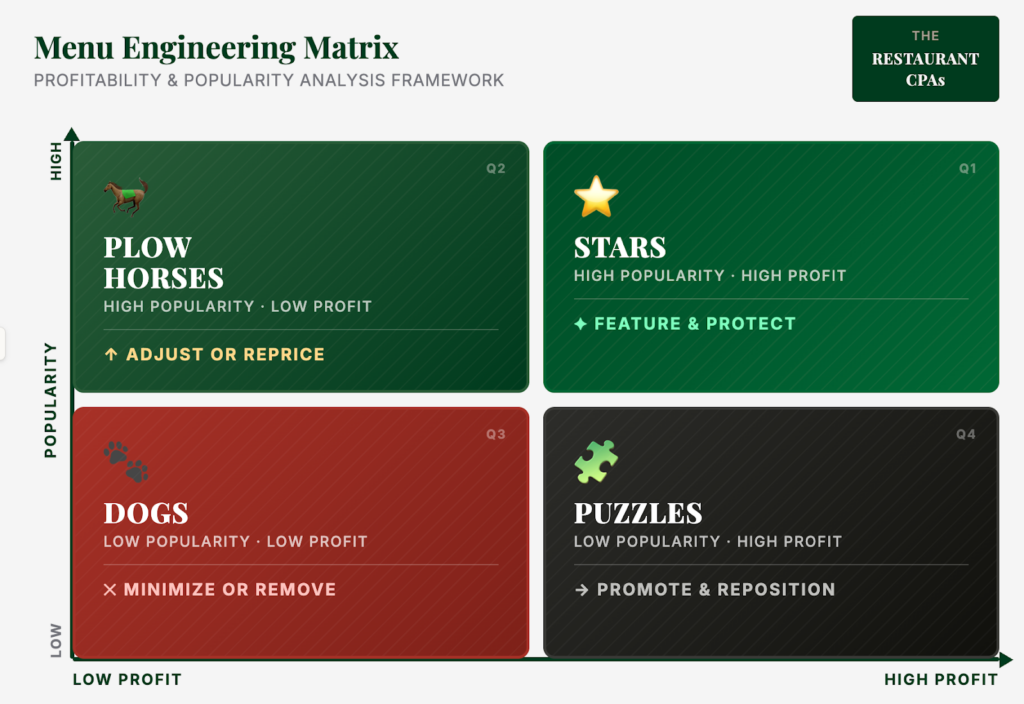
The foundation of menu engineering is deceptively simple: every item on your menu falls into one of four categories based on two variables: popularity and profitability.
- Items that are both popular and profitable are your stars.
- Items that are neither are dogs.
- Items that sell well but aren’t making you much money are plow horses.
- And items that have strong margins but can’t seem to move are puzzles.
“If you run your menu engineering and the first item on your list is a plow horse,” Bill told me, “you are in a death spiral—you just don’t know it yet. The more you sell your most popular item, the lower your margins go.”
Bill’s framework says you should be engineering your menu, so stars are positioned prominently, plow horses and puzzles occupy the middle, and dogs are at the bottom, except when they serve a strategic purpose (like a kid’s menu).
The real opportunity—and the real challenge—is in the puzzles. These are your high-margin items that guests just aren’t ordering enough of. The instinct is to cut them. The right move is to figure out why they’re being overlooked and engineer your menu around them.
“And that begins the journey of menu engineering: how do you engineer guest choice and context to help people make decisions to buy the products you want to sell them?”
Mistake #2: You’re Going Straight to Price When You Should Be Manipulating Choice First
When margins tighten, the instinct is to raise prices. It’s the bluntest instrument in the toolkit, and it’s often the first one operators reach for.
But Bill made a point that I think about differently now: price is the last thing you manipulate. First, you manipulate choice.
Three Smart Ways To Influence Guest Choice
There are three proven techniques for doing this—anchoring, decoys, and the compromise effect—and none of them require changing a single price point.
- The compromise effect is straightforward: when guests see three options, most will choose the middle one. That’s just human nature. Your job is to make sure the item in the middle is the one with the highest margin.
- Anchoring works by establishing a price reference point that makes your target item look like a value. Bill described walking into Poppy Steakhouse in Las Vegas and seeing a $1,000 tomahawk on the menu alongside a $100 tomahawk. “Of course we ordered the $100 item,” he said. “It seemed like a bargain.” Nobody at that table was ever going to order the thousand-dollar cut. It was never meant to be ordered. It was there to make the hundred-dollar version feel like the obvious, reasonable choice.
- Decoy pricing works similarly. You’re not necessarily trying to sell the decoy item. You’re using it to shape how guests perceive the relative value of what you actually want them to order.
For a deeper look at how psychology drives these decisions, we’ve written extensively about menu psychology principles and the behavioral science behind what guests actually order.
Mistake #3: You’re Starting with the Wrong Number—Price Instead of Margin
This might be the single most important mindset shift in this entire conversation, and Bill said it plainly enough:
“Price has nothing to do with your profit. Margin is your profit. It may be a lower-priced menu item with a higher margin because the ingredient cost is lower. So always start with your margins. That’s the part that you put in your pocket and take to the bank.”
Operators get seduced by top-line revenue. A $48 entrée feels more impressive than a $22 one. But if the $22 item has a 72% margin and the $48 item has a 38% margin, you’re far better off selling more of the $22 item. And yet most operators don’t think about their menu this way, because they’ve never mapped it out.
This is where the actual mechanics of menu engineering begin: you have to know your margins before you can engineer anything. That means real recipe costing—not approximations, not gut feel, but actual food cost percentages for every item in every category. And don’t forget about labor.
“Sometimes what people find out is that they’re actually spending more in labor than they are in food cost for a very high degree of prep items,” Bill said. “An item that looks profitable on paper can be a money loser when you factor in the hourly cost of the prep work required to produce it.”
Additionally, part of why so many operators are in the dark here is that their data was never set up to answer margin questions in the first place. Matt made a point about this that I think a lot of operators will recognize:
“When most of us built out our POS systems, we weren’t thinking about menu engineering at all—we weren’t strategically categorizing or placing everything into neat boxes we could analyze later.”
The result is a system that tells you what sold, but can’t tell you what was actually worth selling.
Mistake #4: You’re Making Menu Changes Without Measuring What Actually Happened
Here’s one I lived through personally. We’d do a big menu overhaul, and then we’d have a bunch of spreadsheets in front of us, trying to piece together whether it worked.
Matt framed this problem in a way that made a lot of sense to me:
“How often do we raise something a quarter just to offset a new labor price increase and find out that the menu item went down? And then you’re sitting there on a spreadsheet trying to figure out, did my profitability stay the same? Did I lose out? What happened?”
The answer, historically, was that most operators didn’t really know. They made a change and hoped for the best.
What’s changed is that AI now makes it possible to A/B test menu decisions the way sophisticated marketers test ad campaigns. The concept is simple: you establish a baseline of how an item was performing before a change, make the change, then feed your sales data into an AI tool and ask it to measure what shifted.
“You could literally just do a two-week period before and a two-week period after,” Matt explained. “AI will do all that consultative math behind the scenes—not only did I see a change in the raw number of this item being ordered, but I actually see a change in the percentage ordered compared to the rest of your items.”
Bill added a nuance that I think gets missed: when you’re evaluating the impact of a change, your sales data is only part of the picture. Guest sentiment—reviews, loyalty program feedback, direct server conversations—adds context that the numbers alone can’t provide.
Asking your servers why a guest ordered a particular item. Noticing when a review mentions that the menu “felt expensive” right after a price change. These signals matter, and they belong in the same conversation as your sales mix data.
Mistake #5: You’re Treating Menu Engineering as a One-Time Event Instead of an Ongoing System
This is the operational failure mode I see most often in multi-unit groups that are scaling.
Bill’s recommendation on cadence is worth taking seriously:
- For the baseline analysis, you want 30, 60, or ideally 90 days of data to flatten out weather events, holidays, and anomalies.
- But once you’ve made a change, you want to be looking at results almost daily, feeding your sales data in and asking whether you’re trending in the right direction.
The goal isn’t to be constantly overhauling your menu. It’s to build a rhythm where you’re regularly checking your mix, watching your margins, and making targeted, intentional adjustments, rather than letting costs drift until you’re forced into a blunt price increase.
Where AI Fits Into the Menu Engineering Conversation
Matt made a great point that I keep coming back to:
“We as an industry have run inefficiently for so long. The fact of the matter is, we’re leaving percentage points on the bottom line in an industry where every percentage point means the difference between making payroll, going out of business, or thriving.”
AI doesn’t fix bad operations. It doesn’t replace the judgment that comes from knowing your customers, your market, and your brand. But it does something that wasn’t possible even five years ago: it makes sophisticated analysis accessible to operators who don’t have a CFO or a full analytics team.
The practical starting point Matt recommended is simple:
- Take a POS export.
- Upload it.
- Ask AI to rank your items by units sold within each category.
- Then bring in your recipe costs (even rough ones) and ask it to calculate your margin by item.
You’ll have a version of the four-quadrant framework in about 15 minutes. It won’t be perfect. It won’t replace purpose-built back-of-house software for your ongoing operations. But it gets you off the sidelines.
As Matt pointed out,
“Instead of having to bring in really expensive consultants that are going to teach you how to play chess, you can actually just go to AI and AI can walk you through exactly how to play.”
The barrier to getting started has never been lower.
From there, you test. You measure. You adjust. You build the habit.
The Future of Menu Engineering
For restaurant operators with two or three locations who are thinking seriously about growth, menu engineering is one of the highest-leverage things you can be doing right now because getting your unit-level economics right before you scale is what separates groups that expand confidently from those that watch margins erode with every new location.
The pricing ceiling for most restaurants is real. Guests have absorbed 30% menu price increases since COVID, and there isn’t an unlimited runway left. The operators who will thrive in the next few years will be the ones who understand their margins, engineer their menus deliberately, and build systems for measuring what’s actually working.
If you’re looking for a financial partner who understands how menu-level economics connect to your P&L, your unit-level performance, and your expansion plans, get in touch.